

YEREVAN, November 17. /ARKA/. Investment company CUBE Invest has entered the Armenian capital market as an issuer of its own bonds for the first time. According to the company, the 5 billion dram issuance was fully placed in a single day, with demand reaching 7.5 billion drams. The initial coupon rate is set at 10.5% per annum, though future rates will depend on decisions made by the Central Bank of Armenia.
What does this mean for investors? How is the yield calculated? How will the company use the raised funds, and what risks should be taken into account? The ARKA news agency explored these questions with Mikael Margaryan, CEO of CUBE Invest.
What happened, and why is it significant?
On September 11, CUBE Invest placed its own bonds, totaling 5 billion drams. According to CEO Mikael Margaryan, demand exceeded supply by 50%—reaching 7.5 billion drams—and the entire issuance was sold within one day.
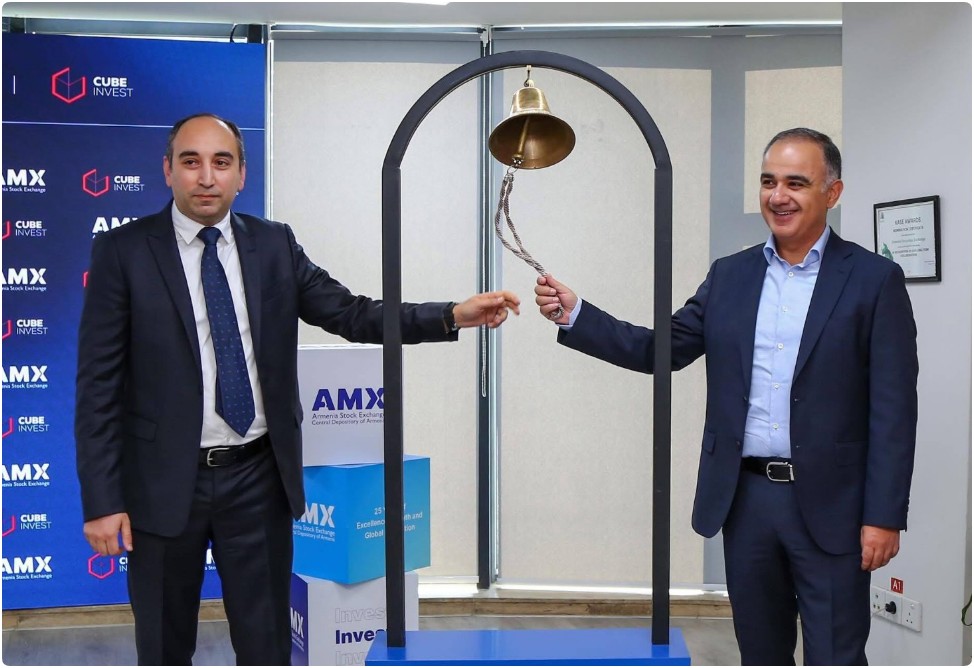
On November 4, the bonds were listed on the Armenia Securities Exchange (AMX). CUBE Invest has become the first investment firm in Armenia to have its own bonds listed on the exchange.
Previously, the company primarily acted as an intermediary in the capital market, helping other organizations secure financing through the issuance of securities. Now, it has become a borrower itself, assuming direct obligations to investors.
This move is also significant for the market as a whole, as it expands the range of issuers beyond banks and enterprises in the real economy.
How much can one earn from CUBE Invest bonds?
The total volume of the issuance is 5 billion drams. It comprises 50,000 bonds, each with a nominal value of 100,000 drams.
The maturity period is three years, ending on September 11, 2029. Coupon payments are scheduled every six months.
A key feature of this issuance is its hybrid interest rate.
For the first six months, a fixed rate of 10.5% per annum applies. Thereafter, it becomes a floating rate, calculated according to the following formula:
the Central Bank of Armenia’s refinancing rate + 4 percentage points.
For instance, on November 3, the Central Bank raised its refinancing rate to 7%. If this rate remains at that level by the time of the first coupon adjustment, the bond interest rate will become 11% per annum.
For a single bond with a nominal value of 100,000 drams, a simplified calculation looks as follows:
• At a rate of 10.5% per annum, the coupon payment for a six-month period would be approximately 5,250 drams.
• At a rate of 11% per annum, the payment for the corresponding six-month period would be approximately 5,500 drams.
These are estimated figures—before accounting for potential taxes or investor expenses—and assume the bond is held for the entire duration of the coupon period. The actual amount is calculated in accordance with the terms of the issuance.
However, 11% is not a guaranteed rate for the remaining two and a half years.
If the Central Bank lowers the rate to 6%, the coupon will be 10% per annum. If it raises the rate to 8%, the coupon will increase to 12%.
As Margaryan explains, this mechanism helps to partially mitigate inflationary risks. When the Central Bank raises its rate in response to inflationary pressure, coupon payments increase accordingly. Conversely, if the rate is lowered, the coupon payment decreases. However, such a correlation does not guarantee complete protection against inflation: changes in the central bank’s interest rate and the actual rise in consumer prices do not always align.
Furthermore, the coupon rate and an investor’s actual yield are not the same thing. When purchasing a bond on the exchange at a price above or below its par value, the final yield will also depend on the transaction price, the holding period, and any associated costs.
Where does the company plan to allocate the 5 billion drams?
According to Margaryan, the funds raised are intended to strengthen liquidity and develop the company’s infrastructure and technological capabilities.
Key areas of focus include enhancing digital platforms, web and mobile applications, and developing new investment products that incorporate artificial intelligence.
Thus, the company views this issuance as a tool to finance the further development of its business.
What is happening in the AI market, and does the current correction signal a downturn for the sector?
In recent days, the U.S. investment market has seen a decline in stock prices, including those of companies linked to artificial intelligence. This trend is partly attributed to the results of the U.S. midterm elections—in which the Democrats secured a victory—and expectations of a stricter approach toward the financing and regulation of AI companies and AI-based systems.
Institutional investors are currently taking a cautious, wait-and-see approach. However, a short-term market decline does not necessarily indicate a downturn for the entire AI industry; when assessing its long-term prospects, it is essential to closely monitor geopolitical and economic indicators.
How reliable is the company, and what does a Fitch rating signify?
On March 19, 2026, the international rating agency Fitch Ratings affirmed CUBE Invest’s Long-Term Issuer Default Rating (IDR) at ‘B−’ while upgrading its outlook from “Stable” to “Positive.”
These are two distinct metrics.
A “Positive” outlook indicates that Fitch sees potential for a future rating upgrade. Nevertheless, the ‘B−’ rating itself remains within the speculative category, which implies significant credit risks. Furthermore, this rating applies to the company as an issuer; it is not a specific assessment of the reliability of any individual bond issuance. In its report, Fitch noted CUBE Invest’s strong financial performance, moderate debt burden, availability of liquid assets, and the gradual diversification of its revenue streams.
At the same time, the agency pointed to the company’s relatively small scale of operations, the concentration of its assets and liabilities, its sensitivity to interest rate and currency risks, and a corporate governance system that is not yet fully developed.
Fitch anticipates that, following a period of exceptionally strong financial results, the company’s revenue and profit will decline significantly in 2026–2027 as market conditions normalize.
In an interview with the ARKA news agency, Margaryan stated that the company’s profit for 2025 reached approximately 8 billion drams, with 3.5 billion drams recorded for the first nine months of 2026, while equity reached roughly 20 billion drams.
According to Margaryan, the 5 billion drams raised through bond issuance do not impose an excessive debt burden on the company. He considers its financial position to be quite stable and sees no cause for concern among investors.
The head of CUBE Invest also emphasized that Fitch evaluates not only the company’s profitability but also the quality of its management, the structure of its assets, and the risks it assumes.
He noted that the improved outlook indicates that the company is moving in the right direction.
Margaryan specifically pointed out that, at the time the rating decision was made, Fitch analysts were already aware of CUBE Invest’s plans to issue bonds.
According to a Fitch report, any further rating upgrade will depend, among other factors, on the expansion and diversification of the business, the strengthening of corporate governance, the improvement of internal controls, and a reduction in risk appetite.
What happens if the company is unable to repay the funds?
This is one of the most critical questions for potential bond buyers.
Margaryan confirmed to the ARKA news agency that the bonds issued are unsecured.
In other words, investors do not receive a claim on specific company assets earmarked as collateral for this bond issue.
To demonstrate CUBE Invest’s financial stability, Margaryan simply compared the figures: the company’s equity of approximately 20 billion drams against the 5 billion drams in liabilities from the bond issuance.
He also emphasized that all investments carry risks, which should be evaluated before committing capital.
According to the company’s head, the high demand for the bonds and the offered coupon yield suggest that the investors who participated in the offering analyzed the proposal and do not currently view the associated risks as significant.
Is it possible to sell the bonds before maturity?
Exchange trading for CUBE Invest bonds is scheduled to begin on November 9, 2026. Investors can execute trades through banks and investment firms that are members of the Armenia Securities Exchange (AMX).
This means that a bondholder does not have to wait until September 2029 to attempt to sell their holdings.
However, a stock exchange listing does not guarantee that a buyer will be available at any given time at the desired price.
In an interview with ARKA, Margaryan noted that while Armenia’s corporate bond secondary market is developing, its liquidity and depth remain limited. According to him, one of the tools for enhancing liquidity is the activity of market makers—market participants who regularly post buy and sell quotes for securities.
Margaryan noted that CUBE Invest itself acts as a market maker for nearly 20 bond issues.
Why is a high interest rate not the only criterion for selection?
In an interview with the ARKA news agency, Margaryan explained that an investor should, first and foremost, evaluate the financial health of the issuer, rather than focusing solely on the offered interest rate.
Key factors to consider, he highlighted, include the company’s profit and liabilities, its debt-to-EBITDA (earnings before interest, taxes, depreciation, and amortization) ratio, and—most importantly—the sources from which the company will service and repay its obligations.
These principles also apply to CUBE Invest’s own bonds.
Does CUBE Invest plan to issue more bonds?
The current issuance may not be the only one.
Margaryan did not rule out further offerings over the next three to five years, though specific timelines, volumes, and parameters for potential future issues have yet to be determined.
He emphasized that the company intends to develop not only as an investment intermediary—helping other organizations raise capital—but also as an issuer in its own right.
“We have a strategic vision for our development, which entails not only supporting other issuers but also maintaining a consistent presence in the capital market as an issuer ourselves,” Margaryan stated.
Thus, CUBE Invest views its own bonds as a potential long-term instrument for financing its business.
What is the takeaway?
CUBE Invest’s entry into the exchange as an issuer marks a new stage in the company’s development and a notable milestone for Armenia’s capital market.
The high demand during the offering demonstrates clear investor interest in the issuance. A hybrid coupon rate allows for payments that fluctuate in line with the central bank’s key rate, while an exchange listing provides the option to sell the securities before maturity.
Furthermore, the company intends to remain active in the capital market as an issuer, though it has not yet disclosed specific plans regarding future issuances.-0-