
YEREVAN, August 23. /ARKA/. The national currency of the Republic of Armenia, the dram, is one of the symbols of independent statehood. The dram was put into circulation on November 22, 1993.
During 30 years of the dram existence, several series of circulating banknotes and coins, as well as other types of currency of the collectors’ interest – circulating commemorative coins, collector banknotes, collector and investment coins – have been issued.
The first collector coin of the Republic of Armenia was issued in 1994. Starting that time the Central Bank of the Republic of Armenia has issued more than 440 names of collector coins made of gold, silver and copper-nickel, dedicated to prominent Armenians and landmark historical and cultural events.
Banknotes and coins of the Republic of Armenia are produced with the use of state-of-the-art technologies offered by security printing and mintage, and meet modern international standards of quality and security.
The consistent and purposive work on improving the quality of the banknotes and coins of the Republic of Armenia has brought in many awards and high appreciation at prestigious international numismatic contests.
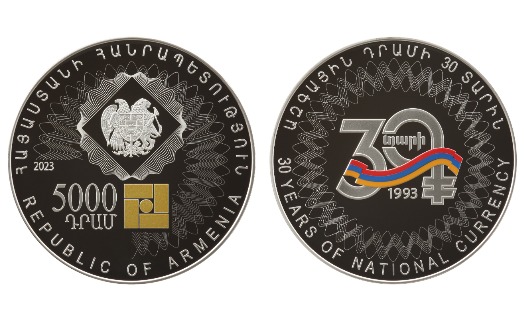
Obverse: the coat of arms of the Republic of Armenia and the logotype of the Central Bank of the Republic of Armenia against the background of guilloche patterns.
Reverse: the logotype of the 30 years of national currency, representing the graphical sign of the dram, the inscription “30 YEARS” in Armenian, the stylized flag of the Republic of Armenia against the background of guilloche patterns.
Designer: Vardan Vardanyan.
The coin is minted at the Lithuanian Mint.
Face value
5000 dram
Metal/fineness
silver 9250
Weight
168,1 g
Diameter
63,0 ??
Quality
proof
Edge
even, numbered
Quantity of issue
400 pcs
Year of issue
2023
Notice
Collector coins are made of precious metals and are issued to present to the society the national, international, historical and cultural, spiritual and other values of the country, to immortalize these values in the metal and to meet the demands of the numismatic market.
Like any other currency the collector coins have face value which makes them the means of payment. However, the face value of these coins is much lower that their cost price which includes the cost of the precious metal used for manufacturing of the coin, mintage and other expenses. Low face value and high cost price allow these coins to be considered as the items of collection and not the means of payment used in money circulation. The collector coins have also the sale price set by the Central Bank of Armenia.
As the items of collection the collector coins are issued in very restricted quantities and are not reissued.
Numismatists, collectors and all interested persons can buy the Armenian collector coins in the sales salon “Numismatist” which is in the building of the Central Bank of Armenia and is open for everyone. -0-