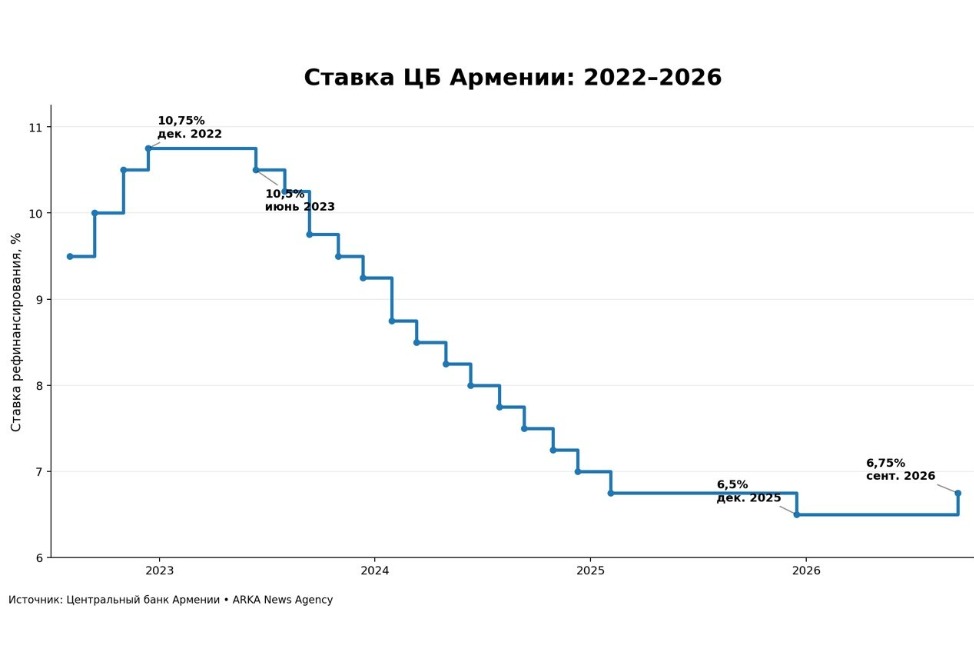
YEREVAN, September 16. /ARКА/. Yesterday, the Central Bank of Armenia raised its monetary policy rate for the first time in over three years. After setting the rate at 10.75% in December 2022, it remained unchanged for several months, and in June 2023, the Central Bank began a gradual rate reduction cycle.
On September 15, the Central Bank Board raised the rate by 0.25 percentage points, from 6.5% to 6.75%. At the same time, the Lombard repo rate was set at 8.25%, and the rate on funds attracted by the Central Bank from banks was set at 5.25%.
From 10.75% to 6.5% – and the first increase
The previous rate increase cycle ended on December 13, 2022. The Central Bank then raised it by 0.25 percentage points to 10.75%.
After this, the rate remained at this level for several months.
A shift toward easing monetary policy occurred on June 13, 2023, when the Central Bank decided to cut the rate from 10.75% to 10.5%. The new rate took effect on June 14.
Thus, June 2023 should be considered the beginning of the rate cut cycle. In August of that year, the rate was cut again, to 10.25%.
Subsequently, the regulator continued to gradually ease monetary conditions, periodically keeping the rate unchanged between individual cuts.
In December 2025, the rate reached 6.5%, after which the Central Bank maintained it at this level at subsequent meetings until September 2026.
On September 15, the direction of the final decision changed: the rate increased to 6.75%. Thus, the rate decreased by 4.25 percentage points from 10.75% in December 2022 to 6.5%, and the September increase returned it to 6.75%.
Why the Central Bank decided to raise the rate
The rate change occurred amid persistent inflationary pressure.
In August 2026, 12-month inflation in Armenia was 4.4%, and core inflation was 4.8%. The Central Bank’s inflation target is 3% (+1%).
Presenting the regulator’s decision, Central Bank Governor Martin Galstyan pointed to several factors that the Council considered when choosing a higher rate path.
The first is strong domestic demand. The Central Bank notes continued high economic activity and the risks associated with increased domestic demand. Among the indicators, the regulator pays attention to, among others, the dynamics of imports of final consumer goods and retail trade.
The second is strengthening external demand. The Central Bank notes an increase in visits to Armenia, which could increase pressure on wages and service prices in the relevant sectors.
Third, there is the risk of increased inflation expectations and external price pressure. The regulator is considering geopolitical risks, the situation in global commodity and energy markets, and the possibility of new supply shocks.
Together with domestic demand, these factors could create more persistent inflationary pressure.
However, the Central Bank’s decision does not mean that the regulator has already determined the next rate hike cycle.
The Council is simultaneously considering alternative scenarios in which a global economic slowdown and other factors could, on the contrary, create disinflationary pressure and suggest a lower rate trajectory.
What does the September hike mean?
The hike on September 15 marks a change in the direction of the Central Bank’s latest decision after a prolonged period of rate cuts and subsequent maintenance at 6.5%.
However, it does not in itself automatically signal the start of a prolonged rate hike cycle.
The Central Bank emphasizes that further decisions will depend on the development of macroeconomic scenarios. The regulator’s task remains to ensure price stability and return inflation to the target level in the medium term.
Furthermore, an increase in the Central Bank’s interest rate does not automatically lead to an immediate and proportional increase in interest rates on commercial bank loans or deposits.
The regulator’s decision influences monetary conditions through the transmission mechanism, but the speed and scale of changes in bank rates may vary.