



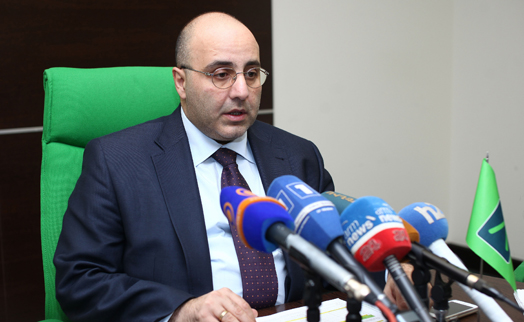
YEREVAN, September 23. / ARKA /. Prior to shifting to mutual settlements in Russian rubles in trading with Russia Armenia needs first of all to form a ruble market, Tigran Jrbashyan, marketing director for Ameria group of companies, told ARKA.
Earlier, Armenian prime minister Hovik Abrahamyan speaking a meeting of prime ministers of the EEU member states in Belarus, floated the idea of reducing the high degree of “dollarization” in trade among Russia, Kazakhstan, Belarus, Armenia and Kyrgyzstan, advocating the shift to Russian rubles in “carrying out mutual trade in strategic goods.’
According to Tigran Jrbashyan, Armenia and Russia have all chances to succeed if they shift to trading in Russian rubles.
“Of course, this will be possible, if we have sufficient amount of ruble-denominated assets. In other words, a ruble market,’ he said.
According to him, for the formation of the ruble market it is necessary to stimulate supply and demand, which is possible if export and import transactions are carried out in rubles.
He said Russian natural gas is sold to Armenia in USD, and many Armenian foods are sold in Russia in USD.
“However, if these transactions are carried out in rubles, we will have a ruble market here,’ he said.
Jrbashyan opined that businesses will adapt to mutual settlements in Russian rubles very quickly, and banks will be able to attract ruble funds to the interbank market from Russian banks.
However, in his estimates, at the moment there is not enough supply and demand for rubles, i.e. exports and imports are not carried out in rubles, with a few exceptions. He pointed out also the absence of the prerequisites for the creation of the ruble market in other member states of the Eurasian Economic Union (EEU), explaining it by the fact that unlike the European Union, the Eurasian Economic Union was primarily meant as a political union.
According to Jrbashyan, the EEU is only feeling the possibility of economic integration, and therefore one should not expect it to use a single currency in the near future.
According to him, the EEU should set up an advisory system of monetary authorities that will promptly notify all the sides about upcoming changes in the financial policy, so that they can prepare for possible shocks. According to Jrbashyan, Russia’s transition to a flexible exchange rate has led to a further devaluation of the ruble, affecting other members of the union and making their products less competitive. -0-


