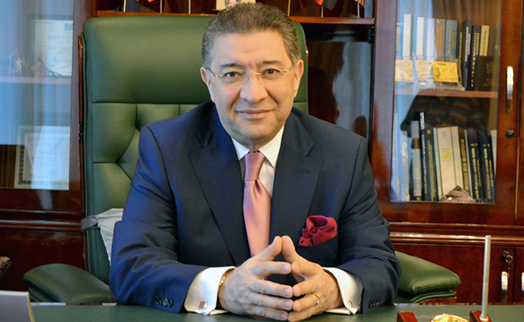
YEREVAN, December 17. /ARKA/. Fitch Ratings’ negative outlook for Armenian banks reflects general things in the country’s economy, Samvel Chzmachyan, the chairman of the Union of Banks of Armenia, told ARKA News Agency.
“The Fitch outlook for Armenian banking sector’s prospects in 2016 was due rather to macroeconomic indicators than to problems inside of the sector,” he said.
Chzmachyan thinks the country’s slow economic growth had adverse impacts on the banking sector.
Among negative factors, he singled out western sanctions against Russia, which led to reduction of money transfers from Russia to Armenia. As the inflow of private money transfers dwindled, Armenian residents’ payment ability fell.
According to the National Statistical Service of Armenia, individual transfers contracted by 32.2% over the first ten months of this year, and those coming from Russia reduced 38%.
Chzmachyan said the share of lending to individuals is not small in Armenian banks’ aggregate loan portfolio.
The Central Bank of Armenia says loan extended to households totaled AMD 760.3 billion and made up 38.6% of the aggregate loan portfolio.
The head of the union also said that corporate clients, particularly exporters, faced difficulties as well.
Armenia’s exports shrank because the ruble’s devaluation against the dollar was more dramatic that that of the dram.
The population’s payment ability was stricken hard by these factors. “People faced difficulties in repaying their loans,” Chzmachyan said.
As a result, the share of nonperforming loans in banks’ loan portfolios grew and the quality of commercial banks’ assets worsened.
According to the central bank’s figures, the share of nonperforming loans in the banns’ aggregate loan portfolio rose to 8% in October 2015 from 6.7% in October 2014.
Besides, world prices for nonferrous metals dramatically sank striking hard at Armenia’s economy, since they make up one third of the country’s exports, Chzmachyan said.
“I think these outside factors will remain also in the next year, and therefore Fitch outlook is quite understandable,” he said.
But despite the mentioned difficulties, he said, Armenian banks are still liquid, since they became more cautious in lending money.
They don’t want to run such a risk of extending loans to everybody. They are now guided by principle ‘the less profit the higher repayment’.
At the same time, Chzmachyan said not everything in the Fitch outlook was negative, particularly the fact that 70% of Armenian banks’ foreign liabilities are long-term loans attracted from international institutional organizations and nonresidents affiliated to banks (parent banks).
“This allows the banks to reduce refinancing risks and prolong repayment deadlines,” he said. “Liquidity situation remains quite controllable also thanks to the central bank’s policy.”
The regulator says the Armenian banks’ liquidity indicator stood at 27.8% in October 2015, while in November 2014 it went down to 24-25%.
The central bank says Armenian banks’ aggregate assets have shrunk 2.1% since the beginning of this year to AMD 3 318.3 billion in September, liabilities have reduced 3.6% to AMD 2 807 billion and credit investments 4.3% to AMD 2 074 billion, while the banks’ aggregate capital has grown 7.2% to AMD 511.3 billion. Their profits totaled AMD 13 129.6 million in Jan-Sep 2015 against AMD 28 160.4 million in Jan-Sep 2014 – a 53.3% year-on-year decline. ($1 – AMD 483.66). —0—-