



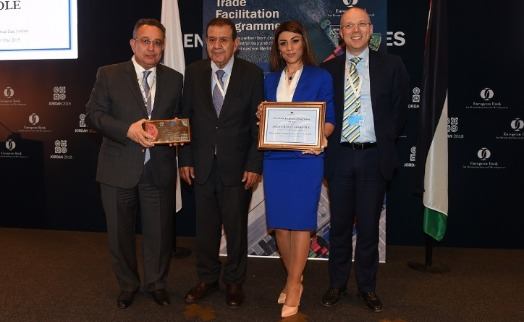
YEREVAN, June 28. /ARKA/. The European Bank for Reconstruction and Development (EBRD) named ACBA-CREDIT AGRICOLE BANK as the “Most Active Issuing Bank in Armenia in 2017” under the EBRD’s Trade Facilitation Program (TFP).
ACBA-CREDIT AGRICOLE BANK won the EBRD award based on the number of trade-related transactions executed during 2017, the Yerevan-based bank said today in a press release.
ACBA-CREDIT AGRICOLE BANK CEO Hakob Andreasyan said the bank increases the volume of SME services on a regular basis, expanding concurrently the range of its products, making them more flexible and corresponding to modern trends.
“We introduce constantly a variety of digital solutions, enabling faster delivery of services. ACBA-CREDIT AGRICOLE BANK is one of the most advanced banks in Armenia in terms of tools provided for trade financing and the EBRD’s award is a clear proof of this. We highly appreciate our cooperation with the EBRD, which enabled us to expand our business geography and increase the number of trade-related transactions, “Andreasyan said.
For his part, EBRD Director for Financial Institutions Nick Tesseyman noted that trade finance is an important component of stimulating economic development and growth.
“Our partner banks, providing financial resources, encourage local companies to conquer new markets. The EBRD is proud to be part of all this and this award is an expression of our respect and gratitude to ACBA-CREDIT AGRICOLE BANK,” Tesseyman said.
The European Bank for Reconstruction and Development’s (EBRD) Trade Facilitation Program has been running since 1999. The program aims to promote foreign trade to, from and amongst the EBRD countries of operations and offers a range of products to facilitate this trade.
Through the program the EBRD provides guarantees to international confirming banks, taking the political and commercial payment risk of international trade transactions undertaken by banks in the countries of operations (the issuing banks). It also provides short-term loans to selected banks and factoring companies for on-lending to local exporters, importers and distributors.
During 2017, the participating banks, with the assistance of the EBRD, financed trade transactions in 25 countries to the tune of 1.9 billion euros.
ACBA was established in 1996 as part of EU’s TACIS program. As a result of a long-term and mutually beneficial cooperation between ACBA Bank and the French Credit Agricole the latter became the biggest shareholder of ACBA in 2006, September. ACBA was restructured, becoming a closed joint stock company and was renamed ACBA CREDIT AGRICOLE BANK. -0-


