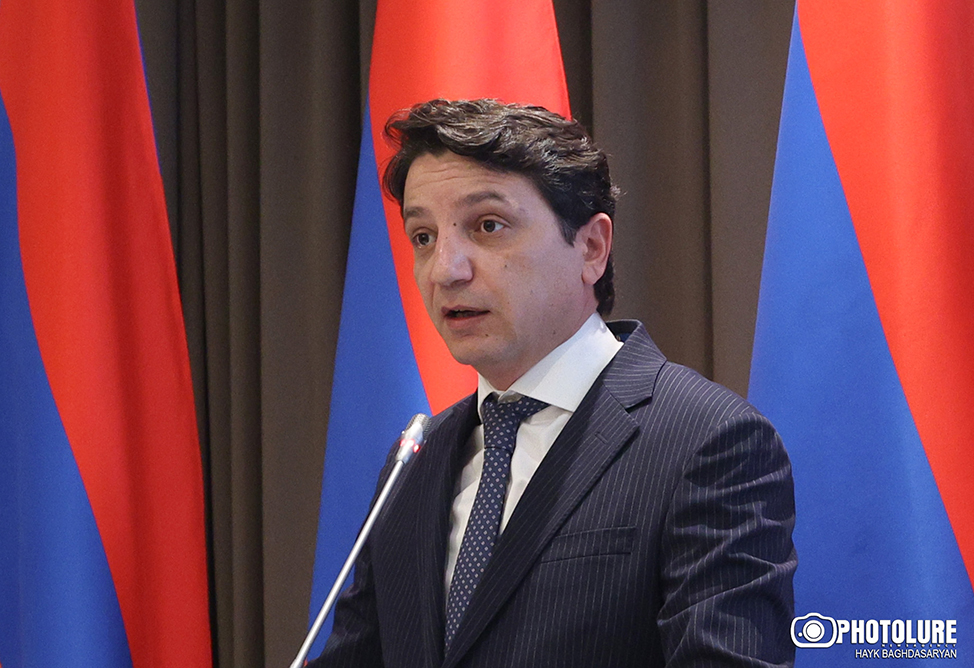
YEREVAN, June 16. /ARKA/. The government of Armenia does not have serious problems with managing the public debt, Finance Minister Vahe Hovhannisyan said today in response to ARKA News Agency’s question about about how manageable the debt is and what the main risks associated with it are.
“At the end of 2024, the debt-to-GDP ratio decreased to 48% from 48.4% at the end of 2023. However, we are concerned about the level of debt and the percentage of debt servicing in our expenditures. Of course, when we try to compare it with international indicators, it is not that high, but, in our opinion, it is necessary to pay serious attention to reducing debt servicing costs and take measures in this direction,” Hovhannisyan said at a press conference.
According to him, debt servicing costs in 2024 amounted to 10.6% (of total budget expenditures), and this indicator is trending upward in 2025 and 2026.
“The strategy of the medium-term expenditure program is precisely to maintain the debt level within 50% of GDP, to curb the growth of debt servicing costs by reducing and stabilizing them within 11-12% of our expenditures,” Hovhannisyan said.
He added that many expenditures also depend on future changes in global interest rates and inflation-related issues.
“We very much hope that the situation will stabilize and that the current high interest rates will decline. We are seeing a certain decline, but it is not enough,” Hovhannisyan said.
According to him, a lot of work needs to be done in this direction to attract new investors, develop new instruments, and issue bonds for diversification.
Commenting on the words of former chairman of the State Revenue Committee David Ananyan that the trajectory of economic processes in Armenia could lead to default, Hovhannisyan called this statement ‘foolish’.
He also rejected the idea that Armenia needs to restructure its public debt, saying the country is not in a debt crisis.
At the same time, he said that negotiations are underway with several countries, in particular Germany, on the Debt-for-Nature Swap program, i.e., the write-off of a certain amount of debt in exchange for the launch of an environmental conservation program.
According to Armstat, Armenia’s total public debt as of April 30, 2025, stood at over $13.6 billion (5,299,574.7 million drams). The external debt stood at over $7 billion, and the domestic debt at at over $6.5 billion (of which $6,542.102 million was government debt and $520.227 million of the Central Bank debt). -0-