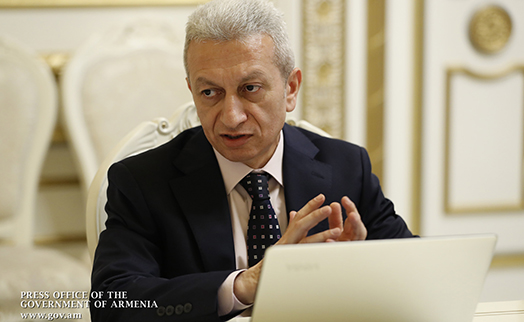

YEREVAN, April 28. /ARKA/. Armenia will increase its debt burden by 260 billion drams amid COVID-19, the budget deficit in 2020 may amount to 324 billion drams, Finance Minister Atom Janjughazyan said at an extraordinary parliamentary meeting convened Tuesday to revise budget indicators.
He said that the need to attract additional debt is estimated at 260 billion drams, since with such a forecast of a decline in GDP (a decline of 2% at the end of the year), a decrease in nominal amount of GDP is also expected, which is instead of the projected 7 trillion 95 billion drams will amount to 6 trillion 485 billion drams.
In his words, accordingly, it will generate tax revenues not in the planned volume of 1 trillion 602 billion drams, but in 1 trillion 433 billion drams, and this is 169 billion drams less than planned.
“During the discussions of the budget, it was planned that there will be higher economic growth and, as a result, higher tax revenues. However, in the current circumstances, unfortunately, the figures are decreasing. This means that the deficit, under other equal circumstances, will amount to 324 billion drams. We plan to keep spending unchanged to mitigate the consequences and create the preconditions for a quick recovery,” Janjughazyan said.
The minister said that to fill the deficit twice as much as planned, it is necessary to attract loan funds.
He said that, taking into account a very high percentage of uncertainty, it is also planned to use other fiscal instruments to mitigate possible negative consequences and create conditions for a quick recovery.
“In essence, this involves the approval of a package of 150 billion drams, where presumably 25 billion drams will be used to alleviate economic problems and social tensions, as well as liquidity issues,” Janjughazyan said.
In his words, about 80 billion drams from this amount are planned to be used to finance long-term economic development programs, and 20 billion drams – for the redistribution of reserve funds, based on need.
“Financing the deficit and 150 billion drams package will require raising an additional 260 billion drams as a debt burden. To do this, it is proposed to amend the budget to provide certain opportunities to exceed existing restrictions in stable conditions and provide for a deficit of 324 billion drams, which will be 5% of the projected GDP,” the minister said.
In the previously approved government budget, economic growth in Armenia in 2020 was projected at 4.9% and inflation at 4% (± 1.5%). The government budget revenue was projected at 1.69 trillion drams and spending at 1.85 trillion drams. The budget deficit amounted to 160.7 billion drams.
According to the National Statistics Committee, the total public debt of Armenia amounted to $ 7 324.167 million at the end of December 2019, after increasing by $ 158.091 million over one month.
The country’s external debt amounted to $ 5 789.729 million at the end of December 2019, showing a growth for the month by $ 163.477 million. About $ 5,300.412 million here is the debt of the Armenian government (an increase of $ 186.278 million), and the debt of the Central Bank of Armenia is $ 489.317 million (a decrease of $ 22.801 million). The country’s domestic debt reached $ 1,534.439 million in late December – down $ 5.386 million. ($ 1 – AMD 479.58).–0–