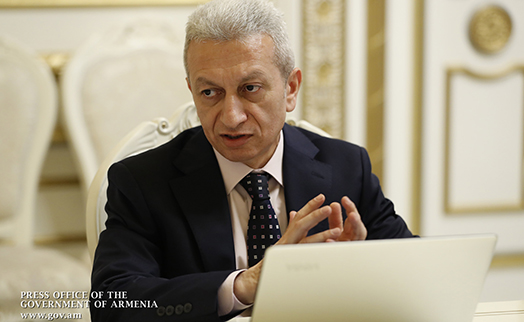
YEREVAN, June 5. /ARKA/. The ratio of public debt to GDP in Armenia is 53.6%, but it is fully manageable and there is the possibility of attracting new funds, Finance Minister Atom Janjughazyan said on Friday, speaking at the National Assembly at the hearings on the 2019 budget performance.
In his words, the country’s total public debt of Armenia at the end of 2019 amounted to $ 7 billion 324 million, of which the government debt is $ 6 billion 835 million and the rest is the debt of the central bank. In the government’s debt, foreign debt alone amounted to $ 5 billion 158 million.
“In fact, the ratio of the total public debt to GDP at the end of 2019 was 53.6%, and only the government – 50.6%. According to all indicators by which the country’s public debt is estimated, by the end of 2019, Armenia is among the countries with a low level of debt burden, and it is believed that the debt is fully manageable,” said Janjughazyan.
The minister said this gives grounds for concluding that the authorities have a certain unused supply and potential that can be used in 2020 to meet the needs arising from the coronavirus.
“Armenia has sufficient creditworthiness, and it is possible to attract loans from both international financial organizations and investors, both on the domestic market and through the placement of T-bills, since there is trust,” Janjughazyan said.
The minister emphasized that at the moment, the creditworthiness of Armenia in the international market is assessed as sufficient, and the ratings are constantly growing.
“As a whole, thanks to our policy, we will not face the problems of attracting public debt. But this does not mean that we can afford to attract so many loans so that they become unmanageable, and our partners were forced to review our rating,” said Janjughazyan.
As he stated earlier, Armenia will increase the debt burden by 260 billion drams amid COVID-19, as a result of which the budget deficit in 2020 may amount to 324 billion drams.
According to the National Statistics Committee, the total public debt of Armenia at the end of December 2019 amounted to $ 7 324.167 million, an increase over the month by $ 158.091 million.
The country’s foreign public debt at the end of December 2019 amounted to $ 5 789.729 million, recording a growth for the month by $ 163.477 million. In the structure of the foreign debt of about $ 5,300.412 million is the debt of the Armenian government (an increase of $ 186.278 million), and the debt of the central bank is $ 489.317 million (a decrease of $ 22.801 million).
The domestic debt of Armenia at the end of December reached $ 1,534.439 million, decreasing by $ 5.386 million ($ 1 – AMD 482.11). -0-