



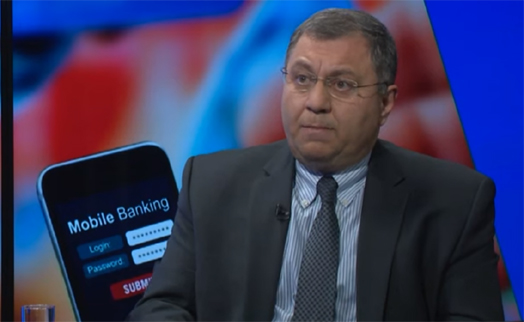
YEREVAN, January 21. /ARKA/. In an interview with Armenian Public Television the Deputy Chairman of the Central Bank Nerses Yeritsyan elaborated on a law passed by the parliament on January 18, 2022 according to which all transactions above 300,000 drams made by individuals must be made in a non-cash method.
The new system will be introduced in stages: first it will come into force in 2022 mid-summer in the capital Yerevan, then in regional centers and in 2024 across Armenia.
According to Yeritsyan, the law is not about fighting shady deals. “The first and the most important task is to protect citizens’ right to make non-cash transactions because business entities will no longer be able to deny it.
‘The law clearly states that the type of payment – cash or non-cash – does not affect the value of the goods,’ he said. “Citizens won’t suffer when buying goods or services because there shouldn’t be any difference in price,” said Yeritsyan.
He stressed that the regulator classifies this law as a “social contract,” in other words, as a good deal between all the beneficiaries, including the state represented by the government and the Central Bank, business entities and citizens.
According to Yeritsyan, the law will enhance financial inclusion and eliminate the risks and inconveniences of cash transactions. Most importantly, according to him, citizens will benefit in the long run as the system will increase digitalization, non-cash turnover, and reduce the shadow economy, which means more taxes collection, less poverty, and more funding for education, science and healthcare.
According to him, this law takes into account the interests of all players. “If we take it as a social contract, because banks, business entities, the Central Bank and the government must make investments to improve the quality of life of citizens and implement a cashless lifestyle, then the availability of financial services will expand, […] in two or three years everyone will forget (about the cash method of payment), there will be a different lifestyle. The world is developing, and this law allows to move our society from the dead point,” he stressed.
“Once this system is enforced, commission payments, at the very least, will not increase; there will be competition among banks to compete for customers. That will lead to lower rates. Nevertheless, the law stipulates that the Central Bank has the power to set upper and lower thresholds for rates in case of violation of competitive rules or manifestation of distortions in the market,” he explained.
“Discussions about cashless transactions in our community have been going on for more than 10 years, and now we believe all parties have an understanding that once the law is passed, everyone will be equally interested in achieving that goal,” Yeritsyan said.
He explained that 35,000 business entities have cash registers with POS capabilities, but they are not active because they are small companies.
“Now we are negotiating for banks to make investments in licensing as a component of social responsibility, so that after the law enters into force in Yerevan in July and in the regions in 2023, payment by card or with smartphones be available for these small business entities,” he said.
Yeritsyan explained that since cashless and electronic services are not widespread in Armenia and people have to pay with cash while shopping, they immediately cash out their paychecks.
“An easy solution would be for people to have a bank account, from which they would pay, for example, electricity or natural gas bills. People will automatically form such a culture,” he said.
In this regard, the deputy chairman of the Central Bank stressed that the “contract”, which is the basis of this legislative initiative, is to increase the experience of non-cash transactions, which will increase the profitability of citizens and prevent the cashing of the entire amount from an ATM.
“In all advanced countries there is a restriction on the circulation of cash. […] Making a payment by tapping a card or phone to a reader is more profitable than handing over paper money, including in terms of hygiene or risk of theft,” Yeritsyan said.
“This way may seem painful to many people now, but the law is written in such a way that citizens do not feel any impact from this transition. On the contrary, the law ensures the right of citizens to make non-cash transactions without additional costs,” stressed Yeritsyan. -0-


