YEREVAN, June 21. /ARKA/. In less than a decade, cryptoexchanges have forged a path forward that usually takes conventional exchanges decades if not longer. Today, Bybit and other platforms provide their customers with broad access to investments and other tools for making money from cryptoassets having become real competitors to conventional exchanges, especially considering that access to the latter is very difficult for ordinary citizens.
However, practice shows that cryptoexchanges do not intend to stand still and are constantly expanding their offers to their customers. In particular, cryptocurrency staking is one such tool. Staking is an alternative to cryptocurrency mining and works on networks that use the Proof of Stake (PoS) algorithm. Many large cryptoprojects, such as Cardano, Tezos, Solana, TRON use exactly the PoS algorithm. Moreover, the second most capitalized cryptocurrency in the world, Ethereum, has been preparing to switch to it for years.
The essence of staking is that users store coins on the PoS algorithm and ensure that the blockchain works, receiving a reward for this. Thus, staking allows Bybit users to receive passive income in the selected cryptocurrency if the latter works on PoS algorithms. It turns out that by its logic, staking is a cryptoalternative to traditional bank deposits and allows increasing capital without serious risks.
Despite the fact that, compared to other crypto deposits, staking involves less risk, nevertheless, the general high volatility of the cryptocurrency market makes such a mechanism seem less attractive than a bank deposit. Yes, in one month with high value of cryptocurrency you can earn much more than by a deposit in the bank. But what if the market starts to fall? Then earnings will fall dramatically, like when many people talk about the onset of a “bear market.” In simple terms, a “bear market” is a relatively long period of decline in the share price of a particular company.
What to do in such cases, when the yield from cryptocurrencies falls day by day? For such cases, Bybit offers USDC Stablecoin Staking. USDC is an open-source, smart contract-based stablelcoin pegged to the value of the U.S. dollar at a 1:1 ratio. Due to its fixed value, USDC allows traders to safely enter and exit positions with volatile cryptocurrencies. The distinctive feature is that each USDC is based on one U.S. dollar or an asset with an equivalent real value held in accounts of U.S. regulated financial institutions.
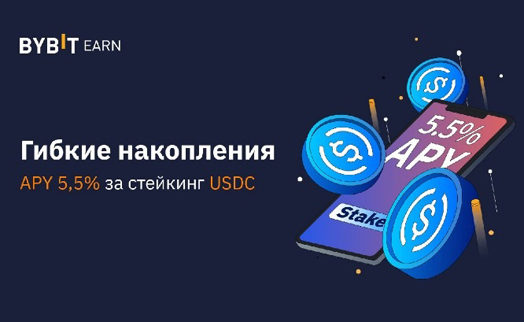
That is, by offering staking of stable coins, Bybit protects its customers from volatility and bearish trends. And in order for users to build up their balance even in a bear market, Bybit has raised the annual return rates for USDC staking! Now users can earn 5.5% annualized yield for staking USDC on the Flexible Saving platform and all they have to do is add 50 USDC or more to their staking. The assets can be withdrawn at any time.
Thus, Bybit’s USDC staking offer is a direct competitor to banks’ FX deposit offers also in terms of protection against market volatility, while suggesting more favorable interest rate offers. -0-