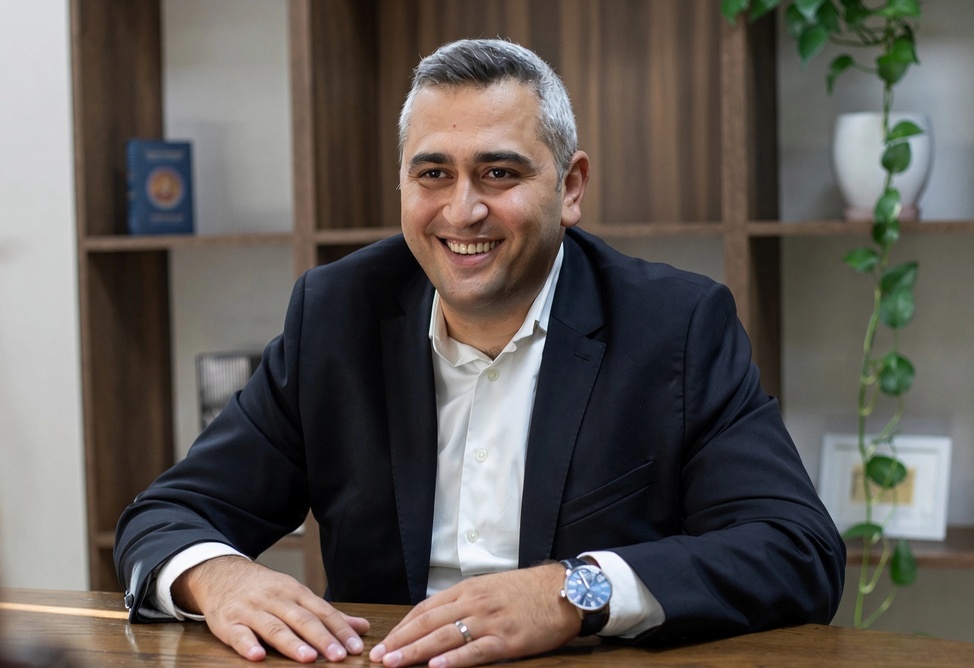
YEREVAN, September 9. /ARKA/. Gor Gevorgyan assesses Armenia’s economy as growing, the country has significant private capital, and the infrastructure and legislative framework for market development as sufficient. However, financing of the economy remains largely based on bank lending. One of the main constraints to the further development of the capital market remains insufficient liquidity, according to Gor Gevorgyan, CEO of the investment company Landmark Capital.
In an interview with ARKA, he discussed the changes he believes are necessary for the Armenian capital market, why private investors alone are unable to solve the liquidity problem, and the opportunities international financial instruments can offer Armenia.
Armbanks highlighted five key takeaways from the interview.
1. The main problem is liquidity, not financial literacy.
The lack of financial literacy among the population is often cited as one of the main obstacles to the development of the Armenian capital market. Gevorgyan disagrees with this assessment.
In his opinion, the key problem is market liquidity. He believes that private investors typically enter an already established market, rather than creating one.
According to Gevorgyan, market liquidity should primarily be ensured by professional participants – banks and investment companies. A liquid market can expand opportunities for subsequent private investor participation.
2. The Economy Needs Alternatives to Bank Lending
According to Gevorgyan, financing of the Armenian economy is still primarily provided through bank loans.
As the economy grows, it is necessary to develop alternative channels for raising capital. Among these, he cites:
• corporate bonds;
• equity financing;
• private financing;
• structured products;
• a more active IPO market in the future.
Thus, the issue is not about replacing bank financing, but about expanding the range of tools available to companies for raising capital.
3. The Armenian market needs international liquid instruments
Another area of development highlighted by the head of Landmark Capital is expanding access to international financial instruments.
In his opinion, the Armenian market is too heavily concentrated on local bonds and Armenia-related assets. At the same time, local financial companies can offer instruments available on Western markets, including international investment funds and ETFs.
Gevorgyan again cites liquidity as a key parameter here: in his assessment, it is one of the primary factors of interest to investors, followed by yield and other instrument characteristics.
4. The spread between Armenian Eurobonds and US Treasuries is at a historically low level – estimate
Gevorgyan also draws attention to Armenian sovereign Eurobonds.
According to his estimate in an interview, their yield is approximately 6.1–6.2%, while the yield on 10-year US Treasury bonds is approximately 4.7%. The difference is approximately 1.4-1.5 percentage points.
Gevorgyan calls this spread historically low and interprets it as a sign of a relatively low risk assessment of Armenia by foreign investors. These figures and their interpretation represent the interviewee’s assessment as of the time of the September 7 interview.
5. Armenia can aspire to become a regional financial hub
Gevorgyan considers Armenia’s development as a regional financial center to be another potential opportunity.
In his opinion, the small size of the domestic market itself is not the main constraint on the development of financial services. The creation of an international-level infrastructure is of greater importance.
Gevorgyan also links this opportunity to the geopolitical situation: capital and business, in his opinion, are interested in jurisdictions capable of ensuring stability within the international financial system.
Bottom Line
Gevorgyan’s five theses come together to form a single overall picture: he associates the further development of the Armenian capital market primarily with increased liquidity, the expansion of non-bank financing channels, access to international instruments, and a more active role for professional market participants.
At the same time, capital market development is not viewed as an alternative to the banking system, but as an expansion of financial infrastructure and opportunities to attract capital for the Armenian economy.
Gor Gevorgyan’s full interview with ARKA news agency
Partner material. The opinions and assessments expressed in this material are those of the interviewee. The information is for informational purposes only and does not constitute individual investment advice or an offer to buy or sell any financial instrument. Investing involves risk, including the risk of losing the invested funds. Past performance does not guarantee future returns.