



YEREVAN, November 10. /ARKA/. In the beginning of the last week prices for gold were under pressure as the U.S. dollar was strengthening.
First of all, this was caused by Japanese Bank’s currency intervention aimed at devaluation of the national currency. The second factor was the doubt that emerged again about Europe’s ability to deter the debt crisis from spreading.
The word of Greece’s intention to hold a referendum put markets into a flutter, prompting investors’ fears that results of the referendum could jeopardize implementation of the eurozone rescue plan.
As a result, gold prices sank to $1681.11 per one troy ounce – the weekly record low.
Gold, however, not only regained its lost value, but also rose to $1767.52 per one troy ounce hitting a new record high in five weeks after it became known that no referendum would be held in Greece.
The U.S. Federal Reserve and European Central Bank’s mild monetary policies prompted investors to buy the precious metal to make an alternative investment.
As a result, gold price went 0.63% up for previous five sessions to $1754.40 per one troy ounce.
Market players’ attention will remain stuck to Greece’s woes also the next week, since Greek Prime Minister George Papandreou has to start negotiating over composition of a new coalition government, which will give the country a chance to receive another tranche of financial assistance from international creditors.
Discord among the country’s political parties can add uncertainty and trigger revaluation of the U.S. dollar. This can put gold prices under pressure. If one troy ounce costs $1680.0 the next week, it will be some support for gold.
This week’s macroeconomic figures will have certain impacts on gold prices. If Greece’s Papandreou manages to settle discord and comply with EU and IMF demands to get financial assistance and if macroeconomic things are discreetly optimistic in the United States and eurozone, gold may continue its upward motion.
Copper price at futures market fell 4.1% last week to $3.5635 per pound. This fall was due to revaluation of the U.S. dollar amid investors’ growing reluctance to risk that was fueled by low prospects for settlement of Europe’s debt troubles and the United State’s unsatisfactory macroeconomic indicators.
Indeed, the number of new jobs in non-agricultural sector was 80,000 in October instead of the projected 95,000.
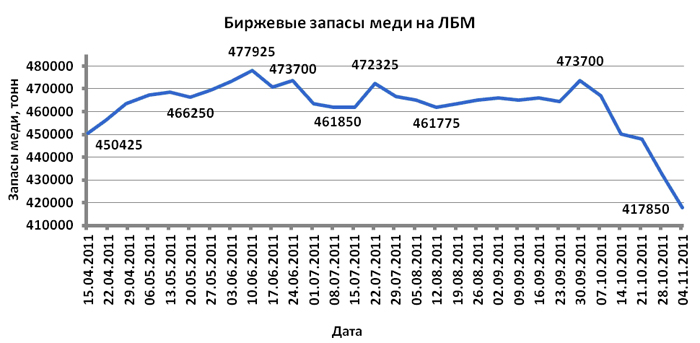
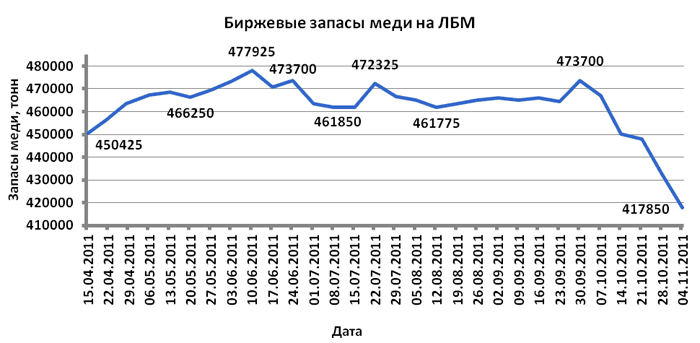
The dwindling supply at London Metal Exchange came as a supporting factor for copper prices.
Copper prices will depend on economic news from the United States, euro zone and China as well as developments connected with Greece.
They will remain vulnerable amid the ongoing uncertainty over provision of another bailout tranche to Greece and discord among its political parties.
Changes in China’s industrial output and its consumer inflation figures, which might be worse in October than in the previous month, may force market players to sell copper.
If the United States and eurozone’s macroeconomic figures are moderately positive and the slowdown in China’s industrial growth is not significant, copper prices will probably rise.
Copper prices at futures market are projected to range between $3.26 and $3.81 per one pound of copper.-0-
Mikael Verdyan, analyst at FOREX CLUB
The author’s opinion does not necessarily coincide with that of the news agency’s editorial board


