YEREVAN, October 20. /ARKA/. Thanks to Stepan Gishyan Foundation, run by ACBA-CREDIT AGRICOLE BANK, human skin for transplantation surgeries will be grown in Armenia, the bank’s press service reported today.
It said the Laboratory of Immunology and Tissue Engineering of the Orbeli Institute of Physiology received funding from the Stepan Gishyan Foundation for acquiring a modern incubator that creates an environment closest to the human body. The incubator will allow, through stem cells, to grow human skin in the laboratory to be used in surgery.
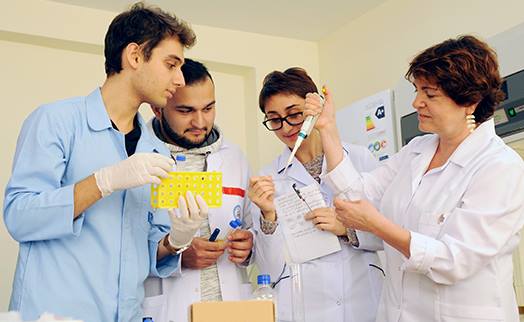
“We acquired a very good incubator. The previous one did not provide sufficient conditions necessary to maintain a viable cell state, and very often our experiments failed due to technical problems,” said Zaruhi Karabekyan, head of the Immunology and Tissue Engineering Laboratory at the Orbeli Institute of Physiology.
She explained that earlier the employees had to make marks on the CO2 gas and temperature scale in order to regulate manually, and now the incubator has a self-regulation function.
“Our first step will be to isolate stem cells from adipose tissue, then we will create a cell database that will be used to grow the skin that corresponds to our gene pool. The cell database will help to obtain various tissues, for example, of the liver, arteries and tissues of organs,” Karabekyan said.
According to Anna Gishyan, the director of the Stepan Gishyan Foundation, it is gratifying that now the scientific work in the laboratory will be carried out with greater efficiency, and students will have the opportunity to conduct practical activities using modern equipment.
“Currently, Armenian doctors receive tissues for skin transplantation surgeries from other countries, and we hope that due to investments from the foundation and the work of our scientists, we will soon have an alternative,” she said.
In 2015, ACBA-CREDIT AGRICOLE BANK, French Credit Agricole, the National Federation of Credit Agricole and the family of Gishyan founded the Stepan Gishyan charitable foundation. This year it has received 128 applications for participation in grant programs. The program of the Immunology and Tissue Engineering Laboratory of the Orbeli Institute of Physiology is one of the four winners of the Foundation’s grants.
ACBA was established in 1996 as part of EU’s TACIS program. As a result of a long-term and mutually beneficial cooperation between ACBA Bank and the French Credit Agricole the latter became the biggest shareholder of ACBA in 2006, September. ACBA was restructured, becoming a closed joint stock company and was renamed ACBA CREDIT AGRICOLE BANK. -0-