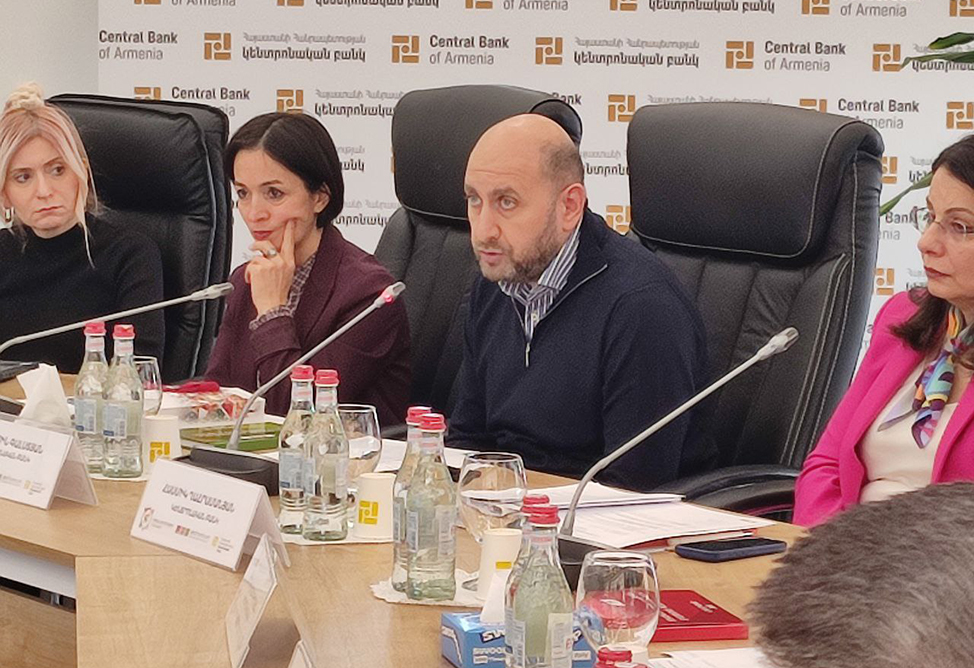
YEREVAN, December 22. /ARKA/. Financial capacity in Armenia has increased, and the established national targets have not only been met but also exceeded, said Martin Galstyan, Chairman of the Central Bank of Armenia, during the presentation of the results of the 3rd national survey (barometer) “Assessment of Financial Capabilities of the Population of the Republic of Armenia.”
New opportunities require new skills
“The financial capacity index in 2025 reached 56.5%, which is higher than both the 50% target set for 2025 and the long-term target for 2031, which is 55%. Overall, over the past five years, based on the results of the second stage of the educational program, the financial capacity index has increased by 9.7 percentage points,” he said at a meeting of the Commission for the Development and Implementation of the Financial Education Program (FEP) in Armenia.
At the same time, according to Galstyan, along with this positive trend, there are also areas where much remains to be done. “This primarily concerns debt behavior or the risks of over-indebtedness. Around 56% of respondents had debt, and among those with loans, the share of those with overdue loans was 19%. In principle, people’s thoughts about borrowing are correct, but their actual decisions sometimes contradict this,” he explained.
Another area, as the head of the Central Bank noted, is respondents’ overconfidence in fraud prevention. People are confident in their financial decisions, but don’t always have sufficient knowledge.
“According to survey results, 93% of people indicated that they reject suspicious financial offers, and 89% do not share their PIN codes with others. Meanwhile, according to surveys, only 55% of people can name at least one type of financial fraud, and only 13% of respondents check the license of providers. This clearly indicates that respondents believe they are capable of protecting themselves, but at the same time, it also indicates a significant knowledge gap,” he said.
Galstyan also stated that the availability and use of financial services has increased significantly, with digital transactions becoming commonplace. This creates new opportunities, but simultaneously requires greater financial skills and responsible behavior.
“We are moving from the analog to the digital world, and the hygiene rules we often adhere to in everyday life are crucial to transfer to the digital environment,” the head of the Central Bank noted.
In this context, Galstyan emphasized the importance of financial education remaining a key tool for ensuring the sustainability and inclusiveness of the financial system’s development.
“It is especially important that this process is implemented in close collaboration with the educational system, forming the foundation upon which the financial decisions of future generations will be built,” he stated.
Future Challenges
In turn, Minister of Education, Science, Culture, and Sports Zhanna Andreasyan noted that financial education is becoming one of the most important indicators of modern education and a literate individual.
“Financial literacy not only helps each person plan and organize their own lives, but also creates a social environment in which, for example, financial fraud is impossible or significantly less likely, and poverty traps, which are formed due to insufficient financial literacy, are much less likely to occur,” she said.
The minister believes that one of the most important tasks of the next stage will be a more integrated approach, as financial literacy is becoming inseparable from media literacy.
“The continuous expansion of financial instruments in the digital environment and on online platforms makes the combination and integration of these two areas inevitable,” she explained.
As a second goal, the minister noted working with school-age children, as this improves the financial literacy of families.
Focus on New Challenges
According to Hasmik Ghagramanyan, Advisor to the Chairman of the Central Bank of Armenia and Chair of the Development and Implementation Commission (DIC), the results of the third National Barometer assessment reflect not only the level of public financial literacy in terms of knowledge but also skills, behavior, and attitudes related to financial management.
“Various activities were implemented, starting with the education of school-age children. A very systematic approach was applied—incorporating elements of financial education into textbooks and specific subjects that may at first glance seem unrelated to financial education, but in fact relate to human consumption and savings behavior. This ultimately leads to the formation of desired behavior, in which a person should be able to independently analyze and make decisions,” she said.
Responding to a question from ARKA news agency, Ghagramanyan noted that the barometer identified new challenges related to fraud, which should be emphasized in other financial education programs.
About the National Barometer
The Financial Education Program, which has been implemented in Armenia since 2014 by the Central Bank in collaboration with its beneficiary partners, aims to assist the population in acquiring financial knowledge and skills, and developing the behavior necessary for the most effective management of personal finances and achieving financial well-being.
The program has a 20-year horizon and is being implemented in four stages. Two stages have been completed to date (2014-2019 and 2021-2024), with an action plan developed based on the results of each. The current, 3rd National Barometer (NBP-2025), was conducted to prepare an action plan through 2031. It aims to assess the level of financial capacity of the population in 2025, conduct a comparative analysis with the previous two studies, and identify financial education priorities for the development of a plan for 2027-2031. The Volga Federal District-2025 survey was conducted among 1,535 respondents over the age of 18 in all regions of Armenia and Yerevan. The 116-question survey was conducted in June-July 2025.