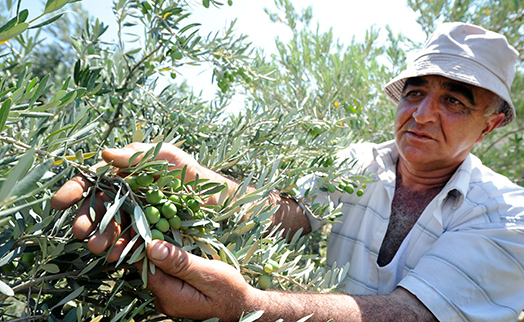
YEREVAN, November 22. /ARKA/. While writing the story about Karen Karapetyan, I remembered another story by late journalist Gogar Isakhahnyan, who worked for Armenpress, of 26th of June 2012:
“The only exemplary olive grove in the country on 7 hectares is located in Araksashen in Meghri yielding at least 10 tons per year. In lieu of dried vineyards the 50-year-old resident of the village of Leyvaz founded an olive garden with 3,400 trees of Seveliano and Askolana species, brought from Spain…. “.
Today, when asked how the idea of cultivating olive trees came to him, Karen Karapetyan says it was hinted by his brother, who read in an encyclopedia about the climatic conditions in which this delicious and nutritious fruit grows.
And the brothers decided to take the risk. In 2002, they planted a few dozen trees, just to try. The seedlings took root, blossomed stretching up to the height of a man. But … the frost had done its dirty deed … But that did not upset Karen, who admits that any other person in his place would have abandoned the endeavor. But not him. With the help from ACBA-CREDIT AGRICOLE BANK in a short time he brought another 7,500 seedlings, distributing some 300 seedlings to friends and just strangers at a village administration meeting. When asked why he did it, the farmer replied, “So that no tree in my grove is stolen.”
Today, there are about 4,000 trees growing in his grove. Last year, Karen Karapetyan gathered 5-6 metric tons of olives. And before that, in 2013, when there was no frost, the output exceeded 10 tons. This year, he hopes to get up to 30-40 tons of the crop. Trees are growing; some of them give up to 70 kilograms of olives.
Karen Karapetyan managed to save the crop from frost, but gathering olives is only part of the whole job. They must be processed and delivered to consumers. He took care of this too. In his native village he founded an olive processing shop. The entire process takes 15 days. Karen thoroughly described to me the entire process of olive processing.
Although the output is ecologically clean, Karapetyan encountered sale problems. Four years ago, the farmer would say, “For the time being I am forced to sell the crop to dealers at a low price – 1,200 drams per one kg. In Armenia it is difficult to sell olives at a normal price.’
Today, the farmer from Meghri has his own consumers. He says with some pride that among them there are Syrian Armenians who have a long tradition of using olives. Some even admit that the olives processed at a small shop in Leyvaz are tastier than factory processed ones. These words give a boost to his pride increasing his desire to advance his business.
… Karen Karapetyan turned to ACBA-CREDIT AGRICOLE BANK for a loan in 2002 to lay out his garden. The Bank took into account the uniqueness of the farmer’s investment and did everything possible to facilitate the repayment scheme. This fact was instrumental for farmer to concentrate on his business’ success. At the end we should say that the brothers are being helped by their sons aged 21 and 25.
We talked about the problems too. Karen Karapetyan and not only him is concerned about the irrigation. Firstly, the cost of irrigation water is relatively high – 1,300 drams per hour. And it is available to few. The Karapetyan brothers built about half a kilometer-long underground water pipeline through the mountains. Now they want to install the drip irrigation system. So far, as usual, the new technology is only being examined. -0-