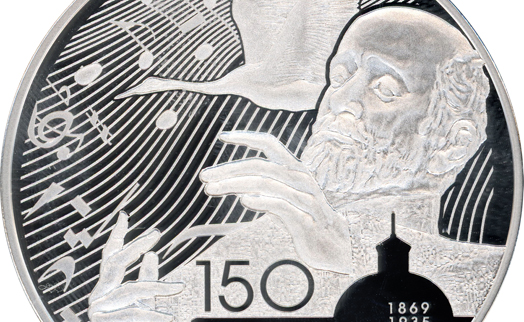
YEREVAN, September 26. /ARКА/. Armenia’s Central Bank has put in circulation today 500 silver commemorative coins dedicated to the 150th birth anniversary of great Armenian composer Komitas.
The obverse of the coin depicts sketches made by Komitas, episodes of the first printed edition of the National Anthem (1891). The reverse depicts a portrait of the composer, a contour of the Gevorkian Seminary and images of Armenian and European musical notes.
The nominal value of the coin is 1000 drams. The coin was designed by Vardan Vardanyan and Eduard Kurghinyan. They were minted in Lithuania.
Soghomon Soghomonian, (ordained and commonly known as Komitas, was an Armenian priest, musicologist, composer, arranger, singer and choirmaster. He is considered the founder of the Armenian national school of music and is recognized as a pioneer of ethnomusicology.
Orphaned at a young age, Komitas was taken to Etchmiadzin, Armenia’s religious center, where he received education at the Gevorkian Seminary. Following his ordination as vardapet (celibate priest) in 1895, he studied music in Berlin. He thereafter “used his Western training to build a national tradition”.
He collected and transcribed over 3,000 pieces of Armenian folk music, more than half of which were subsequently lost and only around 1,200 are now extant. His choir presented Armenian music in many European cities, earning the praise of Debussy, among others. Komitas settled in Constantinople in 1910 to escape mistreatment by ultra-conservative clergymen at Etchmiadzin and to introduce Armenian folk music to wider audiences.
During the Armenian genocide—along with hundreds of other Armenian intellectuals—Komitas was arrested and deported to a prison camp in April 1915 by the Ottoman government. He was soon released under unclear circumstances and experienced a mental breakdown.
The widespread hostile environment in Constantinople and reports of mass-scale Armenian death marches and massacres that reached him further worsened his fragile mental state. He was first placed in a Turkish military-operated hospital until 1919 and then transferred to psychiatric hospital in Paris, where he spent the last years of his life in agony. Komitas is widely seen as a martyr of the genocide and has been depicted as one of the main symbols of the Armenian Genocide in art. -0-