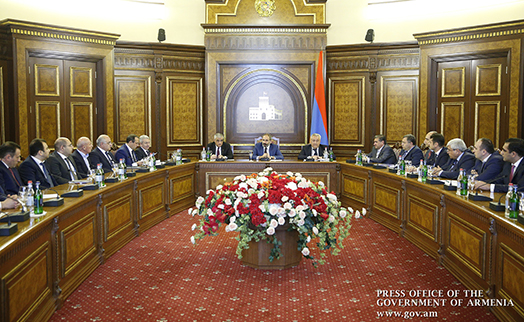
YEREVAN, July 3. /ARKA/. Attended by bank executives, Prime Minister Nikol Pashinyan held a consultative meeting to discuss the problem of accumulated fines and penalties for agricultural and consumer loans, the government press office reported.
“As you may know, for its part, the government has taken some measures and decisions on the matter at hand. We hope that the legislative amendments will allow us to achieve some positive changes in this area and make the bad loans serviced and managed. Of course, this is the most important problem, we promised in April that such solutions will be made, and we hope that there will be significant changes in this field. When we toured across the settlements in the provinces where, unfortunately, there is not so much economic activity; life is not so much vibrant, in all those settlements where we could see crowds, banks or credit organizations operated.
On the one hand indeed, this situation could be interpreted as a certain indicator of economic activity, but unfortunately, when we looked at the faces of the people in attendance of rallies, we understood that they had not gathered for a joyful occasion. We understand the problems faced by the banks and borrowers, and we hope to form such an opportunity for cooperation that will help create conditions for the banking system to give new power and energy to the economy and all spheres of public life,” Nikol Pashinyan said.
The Prime Minister stressed the importance of effective cooperation with the banking system and thanked the bank representatives for similar willingness.
Central Bank Chairman Artur Javadyan said that all banks that are extending agricultural loans have expressed readiness to forgive the debts accumulated before June 1, 2018 as fines for agricultural loans, which will be benefited by more than 100,000 citizens. According to Artur Javadyan, these citizens will have the opportunity to use new financial services. The CBA Chairman noted that work is underway with credit institutions to initiate a similar process. “In fact, the affected citizens return to the starting point, which was at the time of signing the loan agreement. About 100 thousand people could not get a new loan because of a bad credit history. Their credit history will be revoked, and they will have the opportunity to start from a new page,” Nikol Pashinyan stressed.
The representatives of banks noted that the process of cancellation of fines and penalties will be organized as a result of individual work with borrowers, reviewing the terms of repayment of the principal amount by assessing their capabilities.
“The farmer must be in contact with the bank so that each situation could be discussed individually. I think your flexibility is important here. Analyze the situation of each borrower to understand whether there is an opportunity to offer such conditions as might allow the farmer to service his loan. This process will meet its true purpose if we can achieve such a result. This will also have a sanitation effect for the banking system. This is a process that benefits both the State, the borrower, and banks. The effects of this process will not be individual, but much wider,” Prime Minister Pashinyan said.
During the meeting, representatives of banks expressed readiness to consider the issue of cancellation of fines and penalties for consumer and other loans of individuals.
The Prime Minister welcomed their readiness and expressed the hope that in the end this process will benefit to wider layers of society. Nikol Pashinyan also touched on payments for servicing loans and other illogical payments provided by credit institutions, as well as cases of usury.
Artur Javadyan noted that they repeatedly called on citizens to use the services of credit institutions licensed by the Central Bank only, and in all cases of usury to apply to law enforcement bodies. According to Javadyan, there are many such cases, especially in the regions.
“Your information gives us an opportunity to involve law-enforcement agencies in solving this problem. Today, I will instruct the police to create an operational group that will specifically deal with this problem. This information should also be published so that people get informed thereof because they do not know that it is illegal. This is an activity related to usury,” Nikol Pashinyan underscored, adding that based on operational information, the police must ensure the relevant process so that changes could be made in this issue.
The meeting highlighted the measures aimed at curbing the black economy and reducing the need for cash turnover. Views were exchanged about the need to increase the effectiveness of lawsuits related to loan disputes. -0-